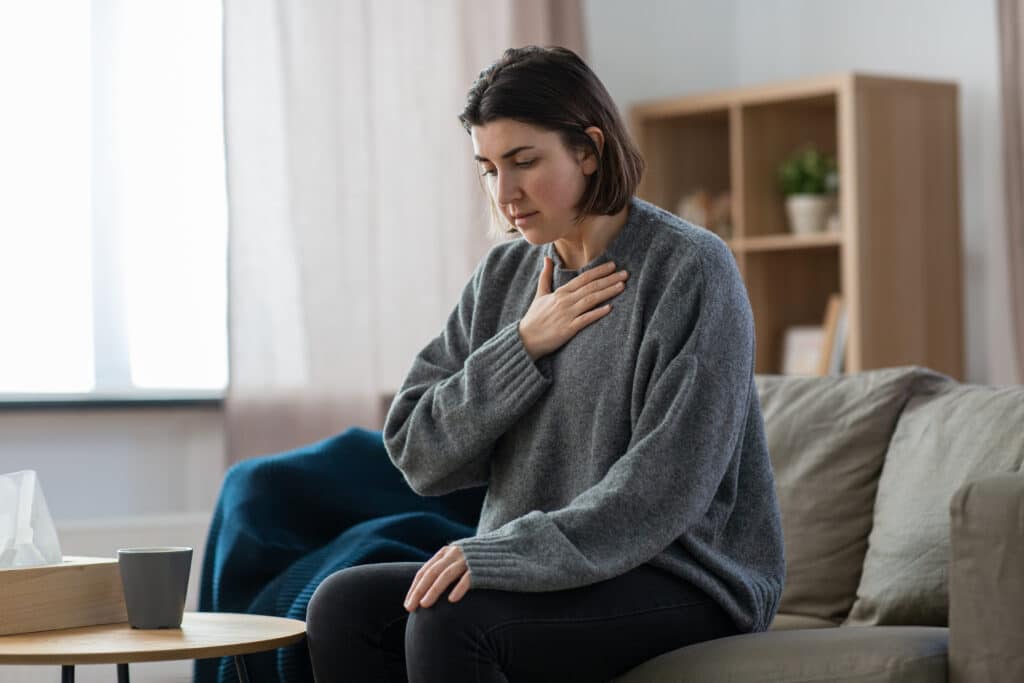

Advanced breathing techniques to stop a panic attack are among the fastest, most accessible tools to regain control when fear spikes suddenly. Panic attacks create intense physical sensations—chest tightness, dizziness, rapid heartbeat, tingling, derealization—that can mimic medical emergencies. According to the National Institute of Mental Health, panic attacks may strike without warning, even during sleep, and often create a sense of losing control or impending doom.1
Traditional deep breathing can help—but advanced, physiologically targeted breathing methods are significantly more effective because they address an underlying driver of panic: CO₂ dysregulation and hyperventilation.
Research shows that people with panic attacks frequently hyperventilate, leading to low end‑tidal CO₂ levels, which intensify sensations like tingling, dizziness, and breathlessness.
This means panic is not just psychological—your breathing plays a real, measurable role, and those patterns can be improved.2
Below are scientifically validated, advanced breathing techniques that quickly interrupt panic—and prepare your body to prevent future attacks.
1. The Physiological Sigh (The Fastest Evidence‑Backed Calm‑Down Method)
One of the most effective advanced breathing techniques to stop a panic attack is the physiological sigh—a pattern your body naturally uses after crying, during sleep, or to self‑regulate stress.3
How to Do It
- Inhale deeply through your nose.
- Take a second, shorter inhale on top of the first (to fully inflate the lungs).
- Long, slow exhale through your mouth.
- Repeat 1–3 times.
Why It Works
A randomized trial comparing breathwork to mindfulness showed that controlled breathing (especially physiological sighs) produced greater improvements in mood and stress reduction. It quickly balances CO₂ levels, slows your heart rate, and activates the parasympathetic nervous system.4
2. Prolonged‑Exhale Breathing (CO₂‑Stabilizing Technique)
Hyperventilation during panic lowers CO₂ too much, creating sensations that fuel fear. To reverse the cycle, you must raise and stabilize CO₂ levels—not just “take slow breaths.”
The most effective method:
- Inhale 4 seconds
- Exhale 6–8 seconds
- Continue for 2–5 minutes
Why It Works
Several studies found that breath practices that increased session length, emphasized controlled pacing, and included guided structure were significantly more effective for reducing anxiety.5
The prolonged exhale activates the vagus nerve and directly inhibits the fight‑or‑flight response.
3. Coherent Breathing at ~6 Breaths per Minute
Slowing your breath to approximately six breaths per minute synchronizes your heart, lungs, and autonomic nervous system.
How to Do It
- Inhale for 5 seconds
- Exhale for 5 seconds
- Continue for 5–10 minutes
Evidence
A controlled study comparing multiple breathing styles found that breathing at 6 breaths per minute produced greater improvements in heart‑rate variability—a marker of calmer autonomic activity—than square or 4‑7‑8 breathing. This makes 6‑bpm breathing especially useful for calming panic‑related episodes of rapid heartbeat. 6
And importantly, this is exactly the breath‑regulation pattern Freespira trains your body to adopt, helping you internalize a stable, low‑arousal breathing rhythm even during moments of high anxiety.
4. Box Breathing (4‑4‑4‑4)
Box breathing paces inhaling, holding, exhaling, and holding again—often used in clinical and hospital settings.
How to Do It
- Inhale 4 seconds
- Hold 4 seconds
- Exhale 4 seconds
- Hold 4 seconds
- Repeat for 1–3 minutes
Evidence
Randomized trials indicate that controlled breathwork—including box breathing—can reduce anxiety and physiological arousal.7
While effective for general stress, box breathing may not regulate CO₂ as efficiently as prolonged‑exhale or coherent breathing—making it a solid backup, but not the strongest anti‑panic option.
5. CO₂ Tolerance Training (The Missing Piece in Panic Relief)
Most breathing guidance focuses on oxygen, but CO₂ tolerance is the real key to stopping panic.
Why CO₂ Matters
Research from anxiety physiology studies shows that individuals with anxiety and panic disorders often have heightened CO₂ sensitivity, meaning they are overly sensitive to sensations of shortness-of-breath, and then respond with hyperventilative breathing.8
Low CO₂ =
- Dizziness
- Tingling
- Breathlessness
- Chest tightness
- Sense of impending doom
These sensations are a panic attack.
How CO₂ Tolerance Training Works
It gently guides you to breathe in ways that:
- Raise CO₂ to normal levels
- Retrain brainstem chemoreceptors
- Reduce sensitivity to CO₂ shifts
- Prevent spirals from starting
This is the science behind Freespira (more below).
6. Grounding‑Breath Hybrid Techniques
Combining sensory grounding with breath pacing improves the effectiveness of panic-interruption.
Here’s an Example:
- 4–6 breathing
- Identify 5–4–3–2–1 sensory inputs
- Physiological sigh
- Resume 6‑bpm breathing
Evidence from anxiety and panic literature shows that grounding interrupts catastrophic escalation while breath‑regulation rewires stress physiology.9
Why These Advanced Techniques Work Better Than “Just Deep Breathing”
Deep breathing alone often makes panic worse if you:
- Inhale too much
- Breathe too fast
- Lower CO₂ further
Deep breathing can unintentionally increase hyperventilation, intensifying symptoms.
Advanced techniques work because they’re designed to:
✔ Correct CO₂ imbalance
✔ Reduce respiratory rate variability
✔ Stabilize autonomic function
✔ Calm the amygdala’s alarm response
These mechanisms have repeatedly been confirmed in panic disorder and respiratory‑biofeedback research, including capnometry‑guided studies in which normalizing end‑tidal CO₂ significantly reduced panic frequency and severity.2
The Limitations of DIY Breathing Techniques
Even evidence‑backed techniques may fall short because:
- Humans cannot sense their CO₂ levels accurately.
- Hyperventilation patterns are habitual and unconscious.
- Panic triggers override self‑guided techniques.
- Panic‑prone individuals often misinterpret sensations, causing a feedback loop.
This is why researchers developed capnometry‑guided respiratory intervention (CGRI)—the technology behind Freespira.
The Freespira Connection: The Most Advanced Breathing Solution for Panic Relief
After exploring advanced breathing techniques to stop a panic attack, the next step is to understand how Freespira elevates this approach.
Freespira is the only FDA‑cleared, at‑home treatment shown to:
- Correct dysfunctional breathing
- Normalize end‑tidal CO₂
- Reduce panic attacks in 28 days
Clinical Evidence
- Real‑world results from over 1,500 people: In a large real‑world study, people using Freespira experienced a 50% drop in panic severity, and 65% reached a clinically significant improvement in their symptoms—meaning their panic attacks noticeably and meaningfully decreased.10
- Clinical trials show Freespira fixes the root problem: Clinical research on Capnometry‑Guided Respiratory Intervention (CGRI)—the technology behind Freespira—shows it corrects hyperventilation, restores healthy CO₂ levels, and significantly reduces panic symptoms. These are the underlying breathing patterns that trigger and fuel panic attacks, and Freespira directly retrains them.2
- Strong and enduring symptom relief: More than 80% of patients reported a major reduction or complete elimination of their panic symptoms after completing Freespira treatment, with evidence of benefit followed to one year post-treatment.11
Why It Works Better Than DIY Techniques
Freespira uses:
- A respiration sensor and a nasal cannula to sample your breath
- Real‑time biofeedback
- Guided 17‑minute sessions
- Weekly coaching
- A structured 28‑day protocol
This eliminates guesswork and retrains your respiratory physiology—not just your mindset.
Learn more:
- How Freespira Works (FDA‑cleared CO₂ regulation)
- Freespira Overview (clinical evidence & outcomes)
- FAQs & Coverage (insurance, VA benefits)
Advanced breathing techniques to stop a panic attack are powerful, fast, and supported by decades of research. But to achieve lasting freedom from panic, you often need more than manual breath control—you need a structured way to retrain the physiological patterns that cause panic in the first place.
That’s exactly what Freespira delivers. Take a free symptom quiz to see if it’s right for you.
FAQ: Advanced Breathing Techniques to Stop a Panic Attack
1. How fast can these techniques stop a panic attack?
Techniques like the physiological sigh can reduce symptoms within seconds because they rapidly restore CO₂ balance.
2. Can hyperventilation really cause panic symptoms?
Yes. Research shows people with panic disorder have lower resting CO₂, which produces sensations like dizziness, tingling, and breathlessness.12
3. Is it safe to use these techniques during an attack?
Absolutely—they’re designed to be safe, fast, and easy to use.
4. Why do panic attacks happen during sleep?
Nocturnal panic attacks can occur without external triggers due to sudden respiratory changes or hyperventilation during sleep.
5. How is Freespira different from breathwork?
Breathwork is self‑guided. Freespira uses real‑time CO₂ measurements to retrain your breathing patterns long‑term, guided by a specialized coach.
6. Can these methods replace therapy or medication?
They can complement treatment, and Freespira is FDA‑cleared as a treatment for panic attacks and panic disorder—but always consult your provider.